The Zamzam Well: History, Facts, and How Pilgrims Access It Today
Few sources of water anywhere in the world carry the weight of history and meaning that the Zamzam Well does. Tucked beneath the marble floor of the Mataf, just steps from the Kaaba, this well has supplied pilgrims with water for thousands of years — and it remains one of the first things new visitors to Makkah ask about.
This guide walks through where the well actually is, what’s known about its depth and history, what modern testing has found in the water, and – just as importantly – how pilgrims access and carry home Zamzam water in 2026.
What Is the Zamzam Well?
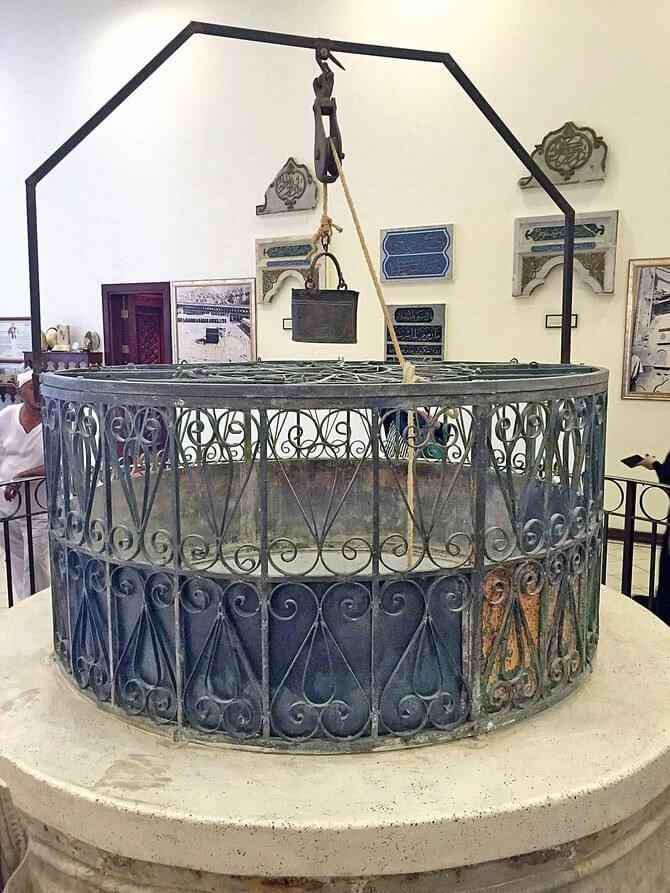
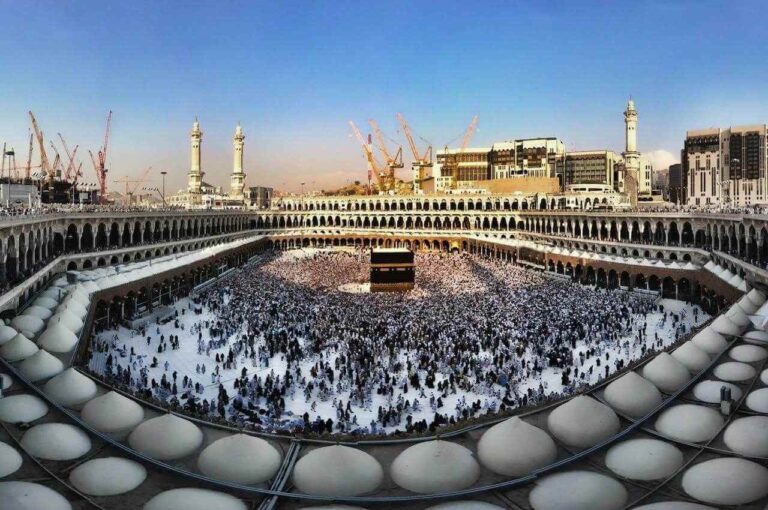
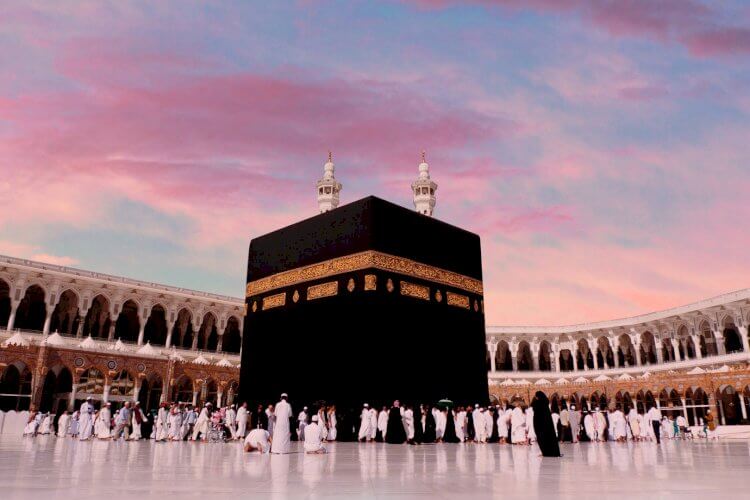
The Zamzam Well is a natural spring located inside Masjid al-Haram (the Grand Mosque) in Makkah, roughly 20 to 21 meters east of the Kaaba, within the Mataf area where pilgrims perform Tawaf. It is considered the source of the cleanest water on earth by believers, drawn from a spring that Muslims regard as a divine gift tied to the story of Prophet Ibrahim’s family.
For Muslims, Zamzam is far more than groundwater. Its story is tied to the migration of Prophet Ibrahim, his wife Hajar, and their son Ismail to the site of the Kaaba. The well has been continuously cared for through successive eras of Islamic history, making it one of the oldest continuously used water sources on the planet.
The Origin Story of Zamzam
According to Islamic tradition, when Ibrahim left Hajar and the infant Ismail in the barren valley of Makkah, Hajar searched desperately for water, running between the hills of Safa and Marwah. The spring is said to have emerged beneath the feet of the infant Ismail, and the flow was so strong that Hajar tried to contain it, repeatedly telling the water to stop – a command from which the well is said to take its name. “Zamzam” is generally explained as meaning roughly “stop flowing,” reflecting Hajar’s attempt to control the overflowing spring.
This origin story is why the ritual of Sa’i – walking between Safa and Marwah, which every pilgrim performing Umrah or Hajj completes – is directly connected to the story of the well.
Zamzam Through Islamic History

The well did not stay in continuous, well-documented use from the very beginning. Traditional accounts describe the well being buried and lost for a long period, until it was rediscovered by Abd al-Muttalib, the grandfather of Prophet Muhammad (peace be upon him). After Abd al-Muttalib re-dug the well, he and his descendants were given responsibility for its care, along with the honor of providing water – known as Siqaya – to pilgrims.
From there, successive Islamic rulers invested in the well’s upkeep. During the Abbasid era, the caliph Abu Ja’far al-Mansur was the first to build a marble structure around the well, cover its opening with a marble lid, and pave the surrounding ground with marble; the structure was later renovated under al-Mahdi, and further modified during the caliphate of al-Mu’tasim. Over the following centuries, Ottoman and eventually Saudi authorities continued to maintain and rebuild the structures surrounding the well as the mosque itself expanded.
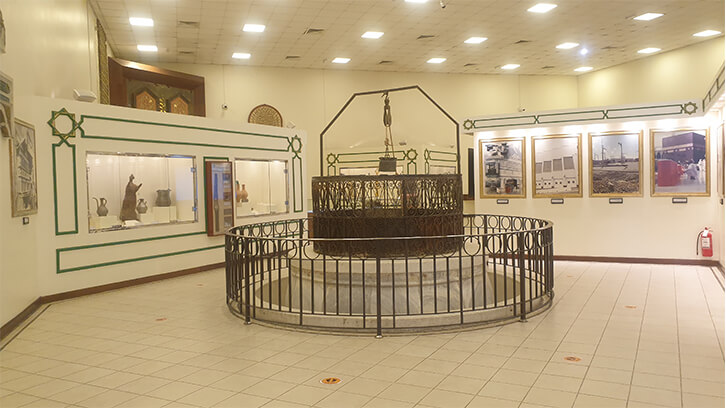
Until 1953, Zamzam water was drawn out manually by bucket — a detail that surprises many modern visitors, who assume automated pumping has always been in place. The original well structure that once stood visibly in the Mataf is now preserved and displayed at the Makkah Museum.
Where Is the Zamzam Well Located, and How Deep Is It?
The well sits about 20 meters east of the Kaaba, inside the boundary of the Grand Mosque, aligned roughly with the Multazam (the wall section between the Kaaba’s door and the Black Stone corner). Sources describe the well’s depth as roughly 30 to 35 meters, dug by hand through rock and gravel layers, with an internal diameter that varies between roughly 1 and just over 2.6 meters at different points down the shaft.
The well draws from an aquifer fed by the Wadi Ibrahim valley system beneath Makkah — part of why it has remained productive for thousands of years despite Makkah’s dry, mountainous, low-rainfall environment.
Can You Still See the Zamzam Well Today?
This is one of the most common points of confusion online, and it deserves a direct answer: no, the well itself is no longer visible as an open shaft in the Mataf. As the Grand Mosque expanded to accommodate millions of worshippers, the area around the well was progressively paved over for safety and crowd-flow reasons. The location is now marked with tiles inscribed in Arabic, set into the Mataf floor, so pilgrims performing Tawaf can identify roughly where the well lies beneath them.
The water itself hasn’t disappeared — it’s still actively pumped from the same source, but through a modern, enclosed system rather than an open well pilgrims can lower a bucket into. This shift, more than any change in the water’s origin, is what separates the historical well from the pilgrim’s everyday experience of “drinking Zamzam” today.
What Makes Zamzam Water Different
Religious significance
Prophet Muhammad (peace be upon him) is reported to have described Zamzam as blessed water, at one point calling it the best water on the face of the earth. A well-known hadith holds that Zamzam water serves the purpose for which it is drunk — meaning pilgrims often drink it while making a specific supplication, whether for healing, guidance, or another personal intention. This tradition is central to why so many pilgrims make a point of drinking Zamzam deliberately and reflectively, rather than simply as a way to quench thirst.
It’s worth being clear-eyed here: these are matters of religious belief and hadith, not medical claims, and this guide treats them as such rather than presenting them as clinical fact.
What modern analysis has found
Separately from the religious tradition, water-quality researchers have studied Zamzam’s chemistry out of general scientific interest. Published hydrochemical analyses describe Zamzam as an alkaline, calcium-carbonate-type groundwater, with higher concentrations of calcium, magnesium, sodium, and potassium than typical drinking water, and total dissolved solids that have varied over time in step with regional rainfall levels. Testing bodies, including Saudi university research centers, have repeatedly found the water’s levels of trace elements to fall within World Health Organization safety standards, and studies have not found the biological contamination (algae, fungal growth) that would normally be expected in a millennia-old open water source.
None of this is medical advice, and this guide isn’t making treatment claims — but it explains why “Zamzam is unusually mineral-rich” is a statement grounded in actual published water testing, separate from its religious meaning.
The King Abdullah Zamzam Water Project
Getting enough safely bottled Zamzam water to millions of pilgrims each year is a serious logistical undertaking, and it’s handled by a dedicated facility: the King Abdullah Zamzam Water Project, based in the Kudai district of Makkah. The project draws water directly from the well, then filters, sterilizes, and bottles it under continuous laboratory monitoring before it reaches pilgrims.
At peak season, the scale is substantial. The packing plant has a maximum production capacity of around 200,000 five-liter bottles per day, with storage capacity for more than 2 million bottles on-site. Ahead of Ramadan, the operator has reported holding a strategic reserve exceeding 2.2 million bottles, alongside more than 750 authorized sales outlets across the Kingdom, as well as smaller bottle sizes distributed through mobile apps. Every batch goes through an automated process from extraction to bottling with minimal manual handling, backed by advanced labs running several hundred quality tests a day.
How to Drink or Collect Zamzam Water in the Haram Today
For a first-time visitor standing in the Grand Mosque, “getting Zamzam” is simpler than it might sound:
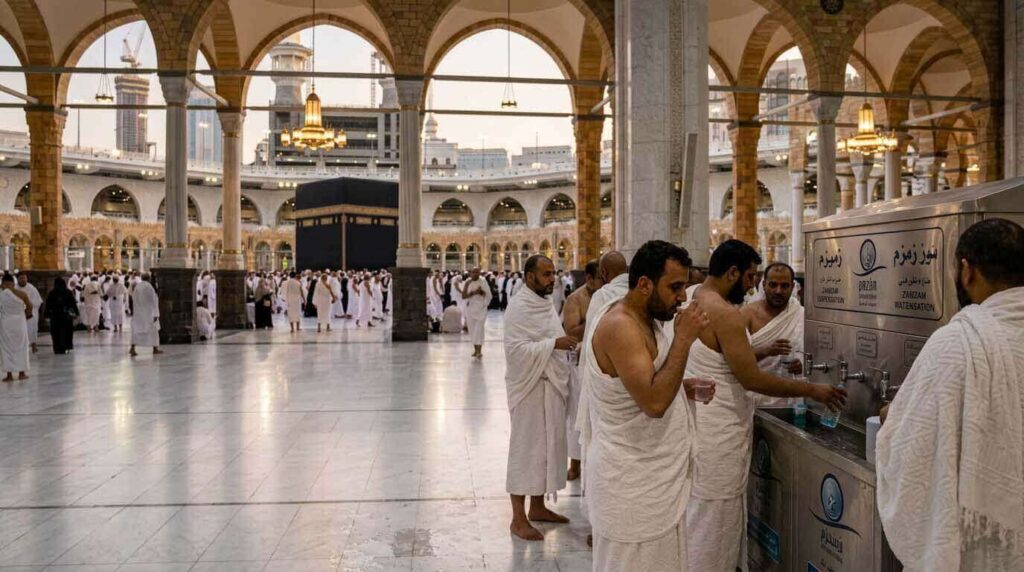
- Coolers and taps. Chilled Zamzam dispensers and drinking taps are positioned throughout the mosque courtyard and prayer areas, both in Makkah’s Haram and in Madinah’s Masjid an-Nabawi, so pilgrims can drink freely at any time.
- Personal bottles at the taps. Pilgrims commonly refill a personal bottle from these public taps and coolers for use during their stay — this is different from taking large factory-sealed bottles through airport security later.
- Sealed bottles for taking home. Beyond the taps, sterilized bottles are available through smart distribution outlets near the Grand Mosque, official distribution centers, and major airports, giving pilgrims an easy way to obtain properly sealed water to carry with them.
- The Kudai distribution center. Pilgrims and residents can also collect larger, factory-sealed bottles directly from the King Abdullah Project’s distribution center in Makkah, alongside the network of authorized retail outlets around the country.
Taking Zamzam Water Home: 2026 Airport Rules
This is the part of the topic that trips up more travelers than any historical detail — and the rules genuinely have tightened over the years, so it’s worth getting the current picture right.
- The standard allowance is one 5-liter bottle per passenger, and it must be the official, factory-sealed bottle — not a container filled personally from a tap or bought loose in the city. Older references to a 10-liter allowance are outdated; the limit was reduced years ago and remains at 5 liters as of 2026.
- The 100ml liquid rule still applies to cabin baggage. A personally filled bottle, of any size, will not pass security screening in carry-on luggage.
- The official 5-liter Zamzam bottle travels separately, not inside your regular checked suitcase. It’s tagged as a limited-release or oversized item at check-in and routed to a separate part of the aircraft’s hold, then collected from the oversized-baggage belt on arrival — not the standard carousel.
- Buy it, don’t fill it. Factory-sealed bottles are sold at official airport counters (including at King Abdulaziz International Airport, Jeddah) and at licensed outlets in the city; airlines will not accept loose or self-filled containers, however well-intentioned the packing job.
- One bottle per traveler, tied to your passport/visa. The allowance is per person and generally can’t be pooled — five separate pilgrims can’t combine their allowance into one large container carried by one of them.
- Check your specific airline before you fly. Rules can vary slightly by carrier and by which Jeddah terminal you’re departing from, so it’s worth confirming with your airline ahead of your return flight rather than assuming the general rule applies exactly to your route.
Planning Your Trip to Makkah
For most pilgrims, a visit to the Zamzam well area is simply part of a broader stay in Makkah that includes Tawaf, Sa’i, nearby Ziyarat sites, and – eventually – either a return home or onward travel to Madinah. If your itinerary includes moving between Jeddah Airport and Makkah, or continuing on to Madinah after your time at the Haram, a private hotel-to-hotel taxi keeps the logistics simple, especially once you’re traveling with a sealed 5-liter Zamzam bottle and the rest of your luggage in tow – no juggling bags across shuttle transfers or worrying about space limits. Bookings can be arranged in advance via WhatsApp at +966574915372.
FAQS
1. Where is the Zamzam well located?
The Zamzam well is inside Masjid al-Haram in Makkah, about 20 meters east of the Kaaba, within the Mataf area where Tawaf is performed.
2. How deep is the Zamzam well?
The well is generally described as roughly 30 to 35 meters deep, dug by hand, with an internal diameter that varies between about 1 and 2.6 meters along its length.
3. Can I still see the open well when I visit the Haram?
No. The well’s opening has been sealed and paved over as part of the Mataf’s expansion for crowd safety. Its location is marked with an inscribed tile on the Mataf floor, but the water is now accessed through taps, coolers, and bottling facilities rather than an open shaft.
4. Does the Zamzam well ever run dry?
Historically, it has remained productive for thousands of years despite Makkah’s arid climate, drawing from an aquifer beneath the Wadi Ibrahim valley. Modern extraction is carefully managed by the National Water Company to sustain supply.
5. Why is Zamzam water considered special in Islam?
Prophet Muhammad (peace be upon him) is reported to have praised Zamzam as blessed water, and a well-known hadith describes it as serving the purpose for which it is drunk. Many pilgrims drink it while making a specific personal supplication.
6. Is Zamzam water scientifically different from regular water?
Published hydrochemical studies describe it as alkaline, mineral-rich groundwater with higher calcium, magnesium, sodium, and potassium levels than typical water, and testing has generally found trace-element levels within WHO safety standards. This is separate from, and doesn’t replace, its religious significance.
7. Can Zamzam water cure illness?
This is a matter of religious tradition and personal belief rather than a medical claim. The hadith describing Zamzam as serving “whatever purpose it is drunk for” is often understood as connected to sincere supplication, not as a substitute for medical treatment.
8. How can I get Zamzam water while I’m in Makkah?
You can drink from the coolers and taps positioned throughout the Grand Mosque, or obtain factory-sealed bottles from distribution outlets near the Haram, the King Abdullah Project’s center in Kudai, or licensed retailers around the city.
9. How much Zamzam water can I take home on a flight?
The standard allowance is one 5-liter, factory-sealed bottle per passenger, purchased from an official outlet — not a personally filled container.
10. Can I carry Zamzam water in my carry-on luggage?
No. Standard 100ml liquid restrictions apply to cabin baggage. The official 5-liter bottle must go through check-in as a separate, tagged item, not in your hand luggage.
11. Can I fill my own bottle with Zamzam water and take it on the plane?
No. Airlines and airport security only accept factory-sealed bottles from official sources; personally filled containers are not permitted through security or check-in.
12. Is the 5-liter Zamzam bottle included in my regular baggage allowance?
Typically it’s treated as a separate, tagged item rather than counted inside your standard suitcase weight, though it’s worth confirming this with your specific airline before departure, as policies can vary.
13. Who currently manages Zamzam water production and distribution?
The National Water Company operates the King Abdullah Zamzam Water Project on behalf of the Presidency for the Affairs of the Two Holy Mosques, overseeing extraction, filtration, bottling, and distribution.
14. What’s the difference between drinking from a Haram tap and buying a sealed bottle?
Both come from the same source. Taps and coolers are for drinking on the spot during your visit; sealed bottles are specifically packaged and certified for taking home, which is what airport security and airlines require for travel.
15. Is Zamzam water available in Madinah too, or only in Makkah?
Zamzam water is distributed to Masjid an-Nabawi in Madinah as well, with dedicated taps and cooling stations, even though the well itself is located in Makkah.