What Is the Kaaba? A Complete Guide to Islam’s Holiest Site
The Kaaba is a cube-shaped stone structure at the center of Masjid al-Haram, the Grand Mosque in Makkah, Saudi Arabia. It is the most sacred site in Islam. Muslims around the world face the Kaaba during their five daily prayers, and every pilgrim performing Hajj or Umrah walks around it seven times as part of the ritual known as Tawaf.
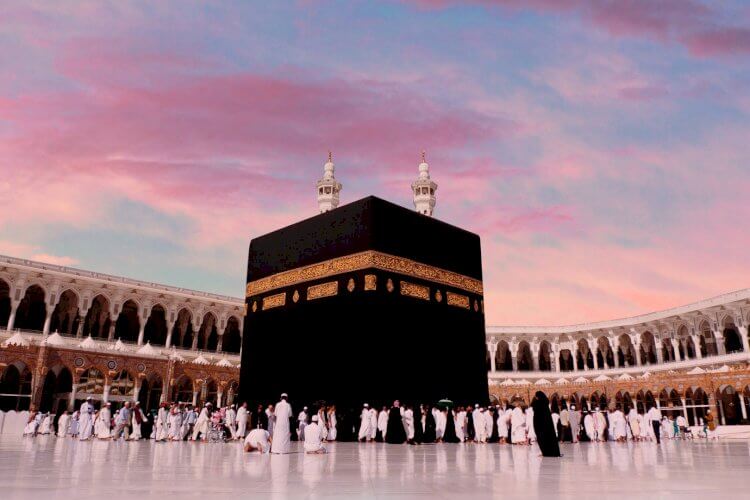
Despite its central importance, the Kaaba itself is a relatively simple building – roughly 13 meters tall, draped year-round in a black silk cloth, with no windows and a single elevated door. Its significance comes not from its size but from what it represents: the direction of prayer for over a billion Muslims and, according to Islamic tradition, the first house of worship built for humankind.
What Does “Kaaba” Mean?
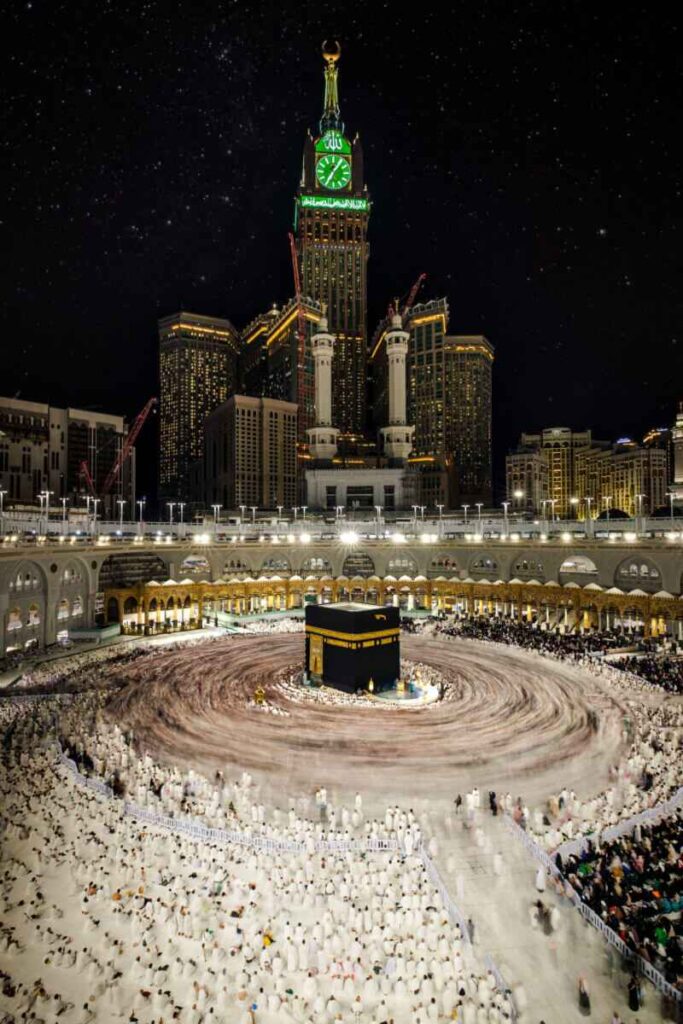
The word Kaaba (Arabic: الكعبة, al-Kaʿbah) means “cube,” a direct reference to its shape. It is also referred to as Bayt Allah (“House of Allah”) or the Sacred House. In everyday and religious usage, “the Kaaba” refers specifically to this single structure – not to the surrounding mosque, which is called Masjid al-Haram.
Where Is the Kaaba Located?
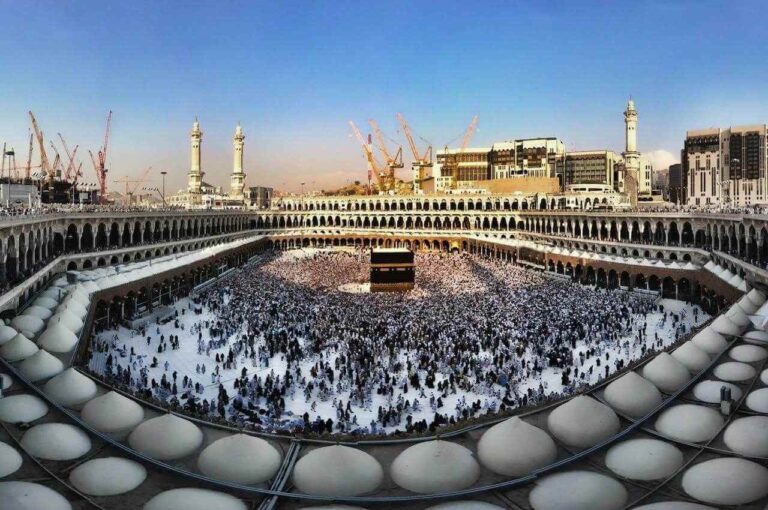
The Kaaba stands at the center of Masjid al-Haram in Makkah, in the Makkah Province of western Saudi Arabia. The mosque itself has expanded around the Kaaba over many centuries, but the Kaaba’s position has remained the fixed center point. Pilgrims performing Tawaf circle the Kaaba within the open marble courtyard known as the Mataf, which sits at the heart of the mosque complex.
Because the Kaaba is inside the boundaries of the Grand Mosque, non-Muslims are not permitted to enter Makkah’s central sanctuary area at all, in line with long-standing restrictions across the holy city.
The History of the Kaaba
Origins and the Abrahamic Foundation
Islamic tradition, based on the Quran, holds that the Kaaba’s foundations were built by Prophet Ibrahim (Abraham) and his son Ismail (Ishmael) as the first house dedicated to the worship of one God. According to this account, Ibrahim and Ismail built the original structure as a rectangle, roughly 14 by 10 meters — notably not the near-perfect cube seen today.
Pre-Islamic Era
Long before Islam, the Kaaba functioned as a polytheistic sanctuary housing statues and idols worshipped by the tribes of pre-Islamic Arabia, alongside the Black Stone already set into its wall. When Prophet Muhammad returned to Makkah in 630 CE, he is reported to have cleared the Kaaba of these idols, restoring it to the monotheistic purpose Islamic tradition ascribes to Ibrahim’s original structure. This is considered a turning point in Islamic history and the moment the Kaaba became the fixed focal point of Muslim worship.
Rebuilding Under Abdullah ibn Zubayr
The Kaaba’s physical form has changed more than once. In 604 CE, before Islam, the Quraysh tribe rebuilt the Kaaba after flood damage but ran short of funds, shortening one side of the structure — the origin of the roughly rectangular-cube shape still visible today, and the reason a small section (Hijr Ismail) sits outside the current walls.
In 683 CE, during a civil war between the Umayyad caliph Abd al-Malik and Abdullah ibn Zubayr (who controlled Makkah at the time), the Kaaba caught fire and the Black Stone reportedly broke into pieces. Ibn Zubayr rebuilt the Kaaba in stone and wood, restoring it to what he understood as Ibrahim’s original dimensions and incorporating Hijr Ismail back into the structure.
After later retaking Makkah, Abd al-Malik reversed part of this reconstruction, rebuilding the Kaaba closer to the smaller Quraysh-era footprint — the version whose general shape has persisted since. Historians note that these accounts come from later literary sources rather than direct archaeological evidence, so some details remain a matter of historical record rather than absolute certainty.
Later Restorations
The area around the Kaaba was expanded under the early caliphs Umar (r. 634–644) and Uthman (r. 644–656) to accommodate growing numbers of pilgrims, and further monuments were incorporated into the sanctuary over time. In the Ottoman period, Sultan Murad IV oversaw a significant 17th-century restoration after flood damage.
In the modern era, the structure has been reinforced and restored multiple times under Saudi administration, most recently with structural work that preserved the historic stonework while replacing deteriorated roofing, ceiling, and support timbers — maintenance intended to keep the building standing for generations to come, even as its footprint and standardized dimensions have remained fixed since the early Islamic reconstructions.
How Big Is the Kaaba? Structure and Dimensions
Because the Kaaba has been rebuilt several times across history, and because sources round measurements differently, you’ll see slightly different numbers depending on where you look. Architectural surveys generally place the current structure at approximately:
- Height: around 13.1 meters (roughly 43 feet)
- Walls: approximately 11.03 meters on the shorter sides and 12.86 meters on the longer sides (commonly rounded to “about 10–12 meters” or “about 35–40 feet” in general references)
This is why the Kaaba is not a perfect cube — its four walls are slightly different lengths, a legacy of the Quraysh-era shortening described above. It is built from Makkan granite, plastered, and covered year-round by the Kiswa, the black silk cloth discussed below.
What Is Inside and Around the Kaaba?
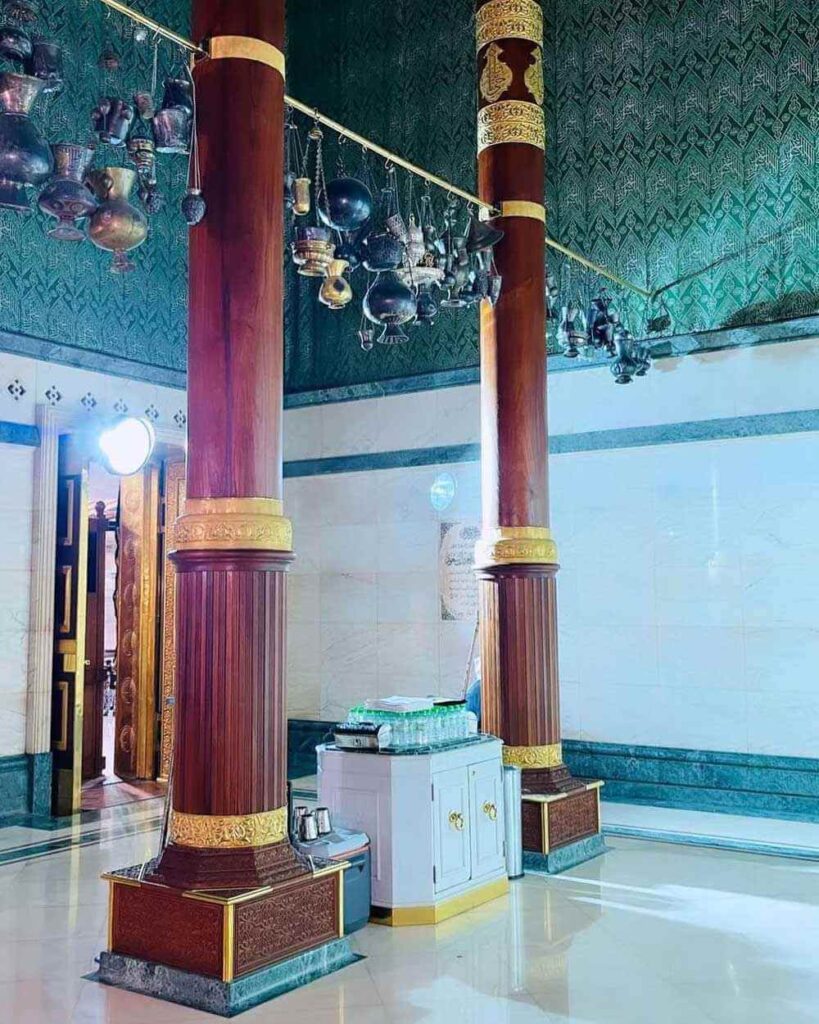
The Kaaba’s interior is not open to the public. It is entered only occasionally, typically by senior officials for cleaning and ceremonial purposes, and contains three interior support pillars along with hanging lamps. For nearly all pilgrims, the meaningful landmarks are the named features on and immediately around the Kaaba’s exterior:
The Black Stone (Hajar al-Aswad)
Set into the Kaaba’s eastern corner, the Black Stone is a dark, fragmented stone about 30 cm across, held together by a silver frame. In Islamic tradition, it is described as having been given to Ibrahim, with some accounts linking it to Adam. Muslims performing Tawaf are encouraged, though not required, to touch or kiss it — it also marks the starting and ending point of each of the seven circuits. Popular tradition holds that the stone was originally white and darkened over time; this is a matter of religious tradition rather than a scientifically documented claim.
The Multazam
The section of wall between the Black Stone and the Kaaba’s door is known as the Multazam, meaning roughly “the place one clings to.” It is regarded as a place where supplications are especially answered, and pilgrims often pause here after completing Tawaf to pray.
Hijr Ismail (the Hateem)
A low, semicircular wall on the northwest side of the Kaaba, Hijr Ismail marks part of the original footprint of Ibrahim and Ismail’s structure that was left outside the current walls during the Quraysh rebuild. Because it is considered part of the Kaaba’s sacred boundary, pilgrims performing Tawaf must walk around the outside of this wall rather than cutting between it and the Kaaba.
Maqam Ibrahim
A small enclosed stone structure just east of the Kaaba, said to preserve the imprint of Ibrahim’s feet from when he stood on it while building the Kaaba’s walls. The Quran instructs believers to take the “standing place of Ibrahim” as a place of prayer, and pilgrims often pray two rakahs near it after completing Tawaf.
Mizab al-Rahmah
The gold-plated rainwater spout on the Kaaba’s roof, positioned above Hijr Ismail, which drains water off the roof during rain. Pilgrims sometimes pray while facing this spout, particularly from within Hijr Ismail.
The Kiswa: The Kaaba’s Black Cloth
The Kaaba is covered year-round in the Kiswa, a black cloth traditionally embroidered with Quranic verses in gold thread. Historically the Kiswa was not always black — earlier periods used white, red, and other colored cloths before the Abbasid era established black as the standard, a tradition the Saudi state has continued.
Since 2022, the Kiswa has been replaced annually on the first day of Muharram (the Islamic New Year) rather than its earlier changeover date, a shift made to keep the changeover clear of the Hajj season. The current Kiswa is produced at the King Abdulaziz Complex in Makkah, a dedicated facility established in 1927 and staffed by around 200 skilled artisans working across weaving, embroidery, gold threadwork, printing, and assembly departments.
Reported figures for a single Kiswa include several hundred kilograms of black silk combined with roughly 100–120 kilograms of gold and silver thread, with total costs cited in the tens of millions of Saudi riyals — making it one of the most valuable religious textiles produced anywhere in the world. Each year, a ceremonial washing of the Kaaba also takes place around this time, using water from the nearby Zamzam well mixed with perfume.
The Kaaba’s Role in Islamic Worship
The Qibla
The Kaaba defines the Qibla — the fixed direction Muslims face during each of the five daily prayers, no matter where in the world they are praying. Mosques everywhere are oriented so their prayer niche (mihrab) points toward the Kaaba.
Tawaf
Tawaf is the ritual of walking around the Kaaba seven times in a counterclockwise direction, performed as part of both Hajj and Umrah, as well as by pilgrims visiting the Grand Mosque at other times of year. Each circuit begins and ends near the Black Stone corner. Tawaf is one of the core rites that every pilgrim completing Hajj or Umrah must perform.
Visiting the Kaaba: What Pilgrims Should Know
Most visitors experience the Kaaba from within the Mataf, the open courtyard immediately surrounding it, or from the elevated levels of Masjid al-Haram during busier periods. Because the Grand Mosque draws enormous numbers of worshippers — particularly during Ramadan, Hajj, and Umrah peak seasons — first-time visitors are sometimes surprised at how the Kaaba appears smaller than expected up close; this is largely a matter of scale against the vast surrounding mosque, which spans a much larger footprint than the Kaaba itself.
For travelers coming from Jeddah, Madinah, or elsewhere in Saudi Arabia, reaching the Grand Mosque is usually the first practical step of the visit. Many pilgrims arrange this leg of the journey through pre-booked private transfers – for example, a direct taxi from Jeddah Airport to Makkah, or an intercity transfer from Madinah – which allow arrival directly at a hotel near the Haram rather than navigating public transport with luggage after a long journey.
FAQs
What does “Kaaba” mean?
Kaaba means “cube” in Arabic, referring to the structure’s roughly cube-like shape.
Who built the Kaaba?
Islamic tradition holds that Prophet Ibrahim and his son Ismail built the Kaaba’s foundations as the first house of worship. It has since been rebuilt and restored several times throughout history.
Where exactly is the Kaaba?
The Kaaba stands at the center of Masjid al-Haram (the Grand Mosque) in Makkah, Saudi Arabia.
How tall is the Kaaba?
Architectural surveys place it at approximately 13.1 meters (about 43 feet) tall, with walls of slightly different lengths — roughly 11 to 13 meters per side.
What is the Black Stone?
The Black Stone, or Hajar al-Aswad, is a dark stone set into the Kaaba’s eastern corner. It marks the start and end point of Tawaf, and pilgrims are encouraged, though not required, to touch or kiss it.
Is the Kaaba empty inside?
The interior is largely empty aside from three support pillars and hanging lamps. It is not open to the public and is entered only occasionally for cleaning and ceremonial purposes.
How often is the Kiswa changed?
The Kiswa, the black cloth covering the Kaaba, is replaced once a year. Since 2022, this has taken place on the first day of Muharram, the start of the Islamic New Year.
Why do Muslims face the Kaaba when praying?
The Kaaba defines the Qibla, the fixed direction of prayer for Muslims worldwide, as established in the Quran.
What is Tawaf?
Tawaf is the ritual of walking around the Kaaba seven times in a counterclockwise direction. It is a core rite of both Hajj and Umrah.
Can non-Muslims visit the Kaaba?
No. Non-Muslims are not permitted to enter the central sanctuary of Makkah, including Masjid al-Haram and the Kaaba.
What is the Multazam?
The Multazam is the section of the Kaaba’s wall between the Black Stone and the door, regarded as a place where supplications are especially likely to be answered.
What is Hijr Ismail?
Hijr Ismail, also called the Hateem, is a low semicircular wall on the Kaaba’s northwest side marking part of the structure’s original footprint. Pilgrims must walk around its outside during Tawaf.
What is Maqam Ibrahim?
Maqam Ibrahim is a small enclosed stone near the Kaaba said to preserve the footprint of Prophet Ibrahim from when he stood on it while building the Kaaba’s walls.
Is the Kaaba the same building built by Ibrahim?
Not physically. The Kaaba has been damaged and rebuilt several times throughout history – most significantly after a 7th-century fire — though tradition holds that later rebuilds aimed to preserve Ibrahim’s original dimensions and location as closely as possible.
How do I get to the Kaaba from Jeddah Airport or Madinah?
Most travelers reach Makkah by road from Jeddah Airport (roughly 60–90 minutes) or from Madinah (roughly 4–5 hours), typically by private taxi, SAPTCO bus, or the Haramain High-Speed Railway, with a private transfer offering direct hotel-to-hotel travel without transfers.